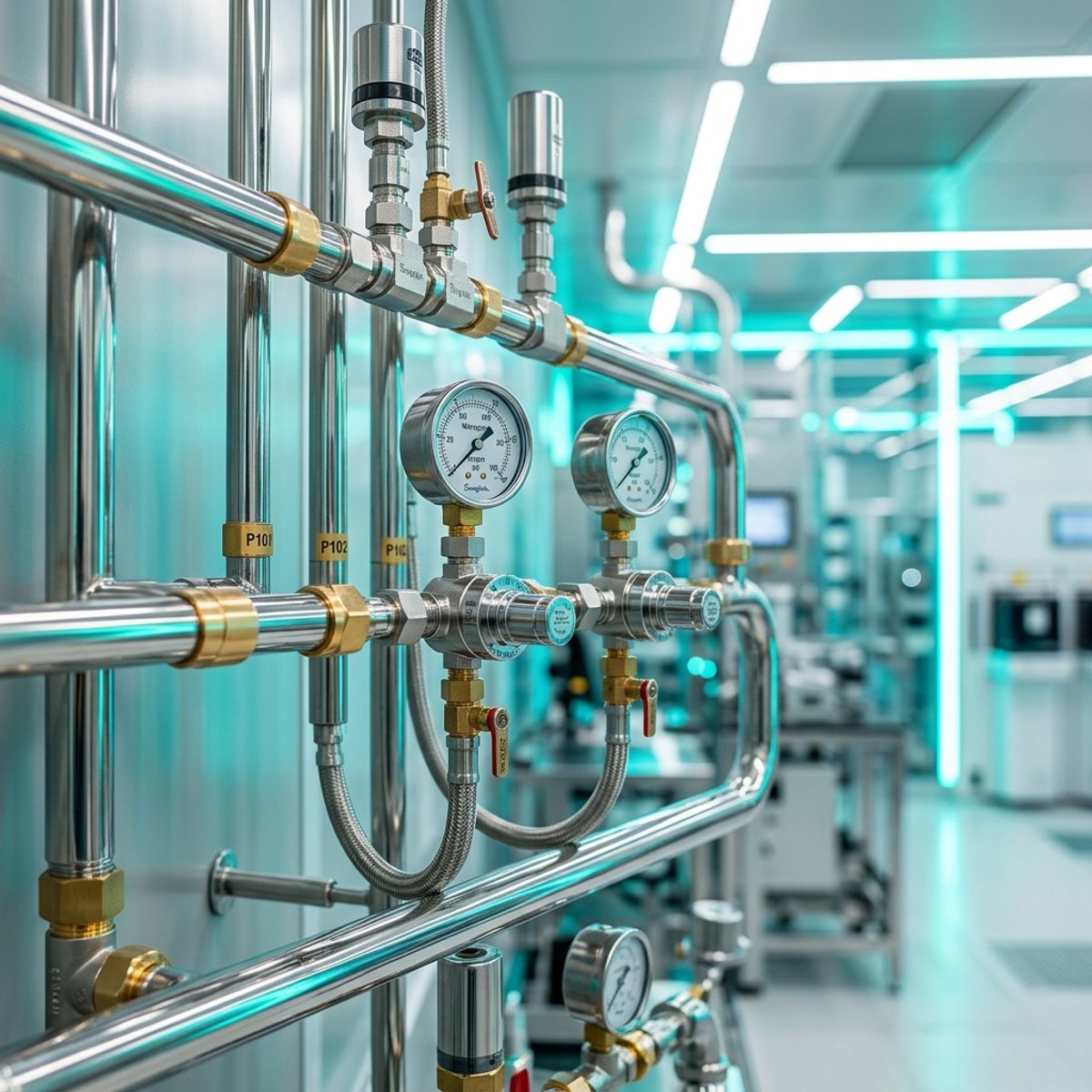
Introduction: The Invisible Killer in the Yield War
At advanced process nodes such as 3nm/2nm, semiconductor manufacturing is approaching physical limits. Process engineers in wafer fabs face extraordinarily stringent challenges: even a single nano-scale particle contamination, or ppb-level residual moisture/oxygen in specialty gases, can trigger crystal lattice defects, causing catastrophic yield losses of millions of dollars per incident.
Post-installation or post-maintenance gas supply lines are extremely long with numerous junctions. Traditional offline sampling certification of gas systems not only typically takes 14+ days, but also easily misses dead-zone contamination. In this context, relying solely on post-hoc sampling can no longer meet requirements. Zolixtech believes that modern semiconductor facilities must establish a dual real-time defense covering both physical contaminants (particles) and chemical contaminants (trace moisture and oxygen).
Engine One: Breaking Physical Limits with Optical Sensing
In ultra-high-purity (UHP) and reactive specialty gas lines, the biggest pain point for online monitoring is that traditional active cavity sensors are easily damaged by high-pressure or corrosive gases, posing risks of leakage and explosion, with extremely high equipment replacement and maintenance costs. Zolixtech's optical sensor engine fundamentally reconstructs the detection logic from the ground up.
Breaking the 0.1μm Barrier in High-Pressure Environments
Utilizing proprietary Mie-scattering passive laser cavity technology, the optical system delivers stable and reliable 0.1μm @ 0.1cfm detection sensitivity at full pipeline pressure (40–150 psig), with an ultra-low false count rate of less than 0.2 counts/minute, enabling second-level precision capture of minute contamination fluctuations.
Scenario Segmentation: Best Practices for UHP and Explosion-Proof Specialty Gases
For inert UHP pipelines (CDA, N2, Ar, He, etc.): The ZHGC-101-01 online high-pressure gas particle counter is typically deployed. By providing in-situ, NIST-traceable online monitoring data, it dramatically compresses the entire gas distribution system's construction or maintenance certification cycle from 14+ days to under 3 days, reducing certification costs by 70%.
For reactive and hazardous specialty gases (HCl, NH3, H2, CO2, O2, silane, etc.): In Zone-rated workshops with extremely high explosion-proof requirements, traditional detectors are strictly prohibited. For this, we deploy the ZHGC-101-02 explosion-proof high-pressure particle counter. Featuring an exclusive explosion-proof safety enclosure and fully 316L passivated stainless steel wetted surfaces, it completely isolates toxic and flammable gases, eliminating ignition sources from within, achieving ultimate safety and truly maintenance-free operation.
Engine Two: Nanoscale Insights from Electrochemical Trace Analysis
If optical sensors intercept the "physical army," then electrochemical sensors are the microscope that catches the "chemical mole." Targeting trace moisture/oxygen signals that are extremely difficult to isolate in complex industrial background gases, Zolixtech employs nano-level trace impurity identification technology, fundamentally overcoming the chronic issues of short lifespan, slow response, and background gas interference that plague traditional electrochemical analyzers.
Dual-Engine Synergy: Optical & Electrochemical Integration
The optical and electrochemical dual engines work in concert, seamlessly connecting to facility MES/SCADA systems via Modbus TCP / RS-485, forming tamper-proof electronic audit trail records. This constructs a 100% closed-loop yield firewall for wafer fabs.