UHP Standard
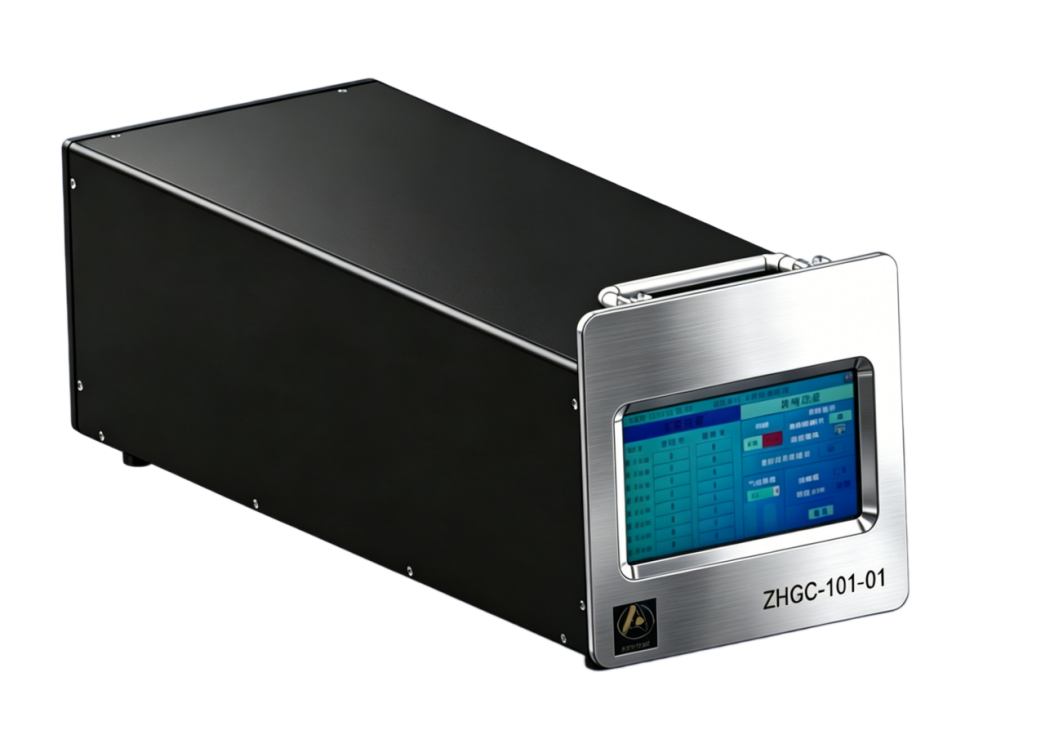
ZHGC-101-01 In-line High Pressure Gas Particle Counter
In-line high-pressure particle counter engineered for wafer fab front-end gas delivery systems. Features a proprietary passive laser cavity achieving 0.1 μm @ 0.1 cfm sensitivity at 40–150 psig. Compatible with N2, Ar, He, and other UHP inert gases. NIST-traceable calibration.
Core Advantages
Cost-Effectiveness
- Provides real-time 0.1μm in-line data, reducing traditional off-line sampling qualification cycles for gas delivery systems from over 14 days to under 3 days, cutting certification costs by 70%.
- In-situ monitoring at full 40-150 psig process pressure eliminates wafer scrap caused by nano-scale particle contamination, directly recovering massive yield losses.
- Seamlessly compatible with CDA, N2, Ar, He, and other semiconductor inert gases, eliminating the need for dedicated equipment per gas line and significantly reducing CapEx.
Process Control Improvement
- Continuously verifies UHP gas purity in-situ, ensuring process gases strictly meet or exceed ISO Class 1 standards before reaching the wafer chamber.
- Features an ultra-low zero count level of < 0.2 particles/min, enabling sub-second detection and early warning of even the slightest anomalies in the gas line.
- Provides high-resolution particle size distribution data across 8 independent channels (0.1μm to 5.0μm), helping engineers quantitatively evaluate the true impact of valve replacements or system modifications.
- Seamlessly integrates with facility MES/SCADA systems via Modbus TCP / RS-485, enabling comprehensive data storage, instant alerts, and fully compliant Audit Trails.
Applications
Gas System Qualification
Pain Point: New or post-maintenance gas delivery systems have long pipe runs and numerous nodes. Traditional off-line sampling easily misses contamination, resulting in qualification cycles exceeding 14 days and delaying fab startup.
Solution: Provides in-situ, NIST-traceable monitoring data, slashing the entire gas distribution system qualification cycle from over 14 days to under 3 days.
Process Gas Monitoring
Pain Point: In advanced 3nm/2nm nodes, nano-scale particles entrained in process gases directly cause wafer crystal defects. A single undetected contamination event can result in millions of dollars in direct yield loss.
Solution: Delivers real-time 0.1μm particle alarms at full pipeline pressure (40-150 psig), instantly intercepting contaminated gas before it reaches the wafer chamber to prevent batch scrapping.
Reactive Gas Monitoring
Pain Point: Traditional active-cavity sensors are easily eroded when monitoring highly corrosive or reactive specialty gases, posing severe gas leak safety risks and incurring prohibitively high replacement costs.
Solution: Utilizes a proprietary passive laser cavity and fully passivated 316L stainless steel wetted surfaces to ensure safe, long-term monitoring of hazardous reactive gases, reducing maintenance frequency by over 60%.
Technical Specifications
Technical Specifications
Physical & Electrical Specs
Frequently Asked Questions / FAQ
Why is 0.1μm-level particle detection in specialty gases critical for advanced semiconductor processes?
In advanced nodes (such as 5nm/3nm), environmental cleanliness requirements are extremely stringent. Any microscopic particle larger than one-tenth of the process node (e.g., 0.1μm) that deposits on the wafer surface via process gases (like CDA, N2, or Ar) can trigger fatal photolithography defects, short circuits, or open circuits, leading to millions of dollars in wafer scrap. Because particle contamination is directly linked to yield rates, adopting real-time high-pressure in-line particle monitoring (rather than traditional 14-day offline sampling) has become an indispensable step for semiconductor fabs to safeguard their baseline yield and mitigate process risks.
Get in Touch
Contact Sales
Interested in the ZHGC series or full-stack gas detection solutions? Let us know your requirements.
sales@zolixtech.com
Headquarters
No. 1427, 14F, Chuangxinghui Finance Building, No. 777 Guanggu 3rd Rd, Wuhan, Hubei